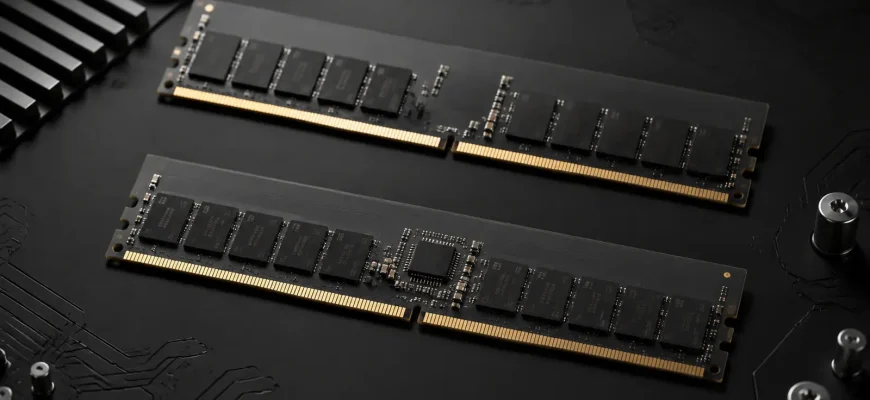
ECC UDIMM and RDIMM are not two performance grades of interchangeable server memory. They are different module types with different electrical designs, platform support and scaling limits. The motherboard and processor memory controller determine which type a server accepts, so compatibility must be resolved before capacity, speed or price.
Decision in brief: choose ECC UDIMM for a compatible entry server when the required capacity fits comfortably within the platform limit. Choose RDIMM for mainstream and high-capacity servers, especially when many DIMM slots must be populated. Never mix UDIMM and RDIMM, and never assume that “ECC” alone establishes compatibility.
- First separate ECC from module type
- ECC UDIMM vs RDIMM at a glance
- What the register changes
- Criterion 1: platform compatibility
- Criterion 2: required capacity over the server lifecycle
- Capacity planning questions
- Criterion 3: memory channels and population
- Criterion 4: rank, speed and mixed configurations
- Criterion 5: reliability and serviceability
- Criterion 6: purchase price and upgrade cost
- Recommended choices by scenario
- Small business application server
- Virtualization host
- Database or analytics server
- Compact edge appliance
- Buying checklist
First separate ECC from module type
Error-correcting code describes the memory system’s ability to detect and correct certain data errors. UDIMM means unbuffered dual in-line memory module. RDIMM means registered dual in-line memory module. An ECC UDIMM provides error correction without the register used by an RDIMM; an RDIMM is built for platforms that support registered memory.
This distinction matters because product listings often shorten “ECC UDIMM” to “ECC memory,” while many server platforms use ECC RDIMMs. Two modules may share DDR generation, capacity and advertised speed yet remain electrically incompatible with the same motherboard.
ECC UDIMM vs RDIMM at a glance
| Criterion | ECC UDIMM | RDIMM |
|---|---|---|
| Command/address path | Unbuffered | Registered on the module |
| Typical platform | Entry server, workstation or compact appliance | Mainstream and high-capacity server |
| Capacity scaling | Lower platform and module ceilings in typical systems | Designed to support more modules and higher capacity |
| Cost | Often lower for small configurations | Higher module cost, but better scaling |
| Latency | Avoids the register stage | Registration adds a stage to command/address handling |
| Interchangeability | Not interchangeable; platform support must be explicit | |
What the register changes
An RDIMM places a register between the system’s memory controller and parts of the module’s command and address path. This reduces the electrical load seen by the memory controller and helps a platform support more memory devices and populated slots. It is a scaling mechanism, not a general promise that every RDIMM configuration is faster.
An ECC UDIMM connects without that register. The simpler path can suit systems with fewer slots and lower maximum memory requirements. Its practical advantage is often platform and acquisition cost. Its practical limit is that the memory controller sees more electrical load as modules are added, constraining the configurations the platform can validate.
Criterion 1: platform compatibility
Compatibility is binary. Check the server’s technical guide, processor documentation and qualified memory list. The guide should identify the supported DDR generation, module type, capacities, ranks and population rules. If the platform specifies RDIMM, buying ECC UDIMM with matching pin count and speed does not make it compatible.
DDR5 also introduces terminology that can mislead buyers. On-die error correction inside a DDR5 DRAM device is not the same as end-to-end system ECC exposed by an ECC memory module and supported by the platform. Procurement documents should state the exact module type rather than asking for “DDR5 with ECC.”
Common mistake: filtering a reseller catalogue by capacity and frequency, then treating all remaining ECC modules as equivalent. Part number, module type, rank, organization and vendor qualification still matter.
Criterion 2: required capacity over the server lifecycle
Size memory for the workload and growth plan, not for the maximum printed on a processor family page. A server with four ECC UDIMM slots may be ideal at 64 GB or 128 GB but become expensive to upgrade if every slot is occupied on day one. A platform with RDIMM support may allow a much larger ceiling and more incremental growth.
Model at least two points: the initial requirement and a credible requirement two or three years later. Record how many slots each configuration consumes. Leaving half the slots empty can preserve an inexpensive upgrade path, but only if the future modules can be added under the vendor’s population rules.
Capacity planning questions
- What is the measured working set under peak load?
- How much headroom is required for failover or consolidation?
- Will virtual-machine density or database cache size grow?
- Can the initial modules remain in place during the planned upgrade?
- Will a higher-capacity CPU or second socket change the memory topology?
Criterion 3: memory channels and population
Capacity alone does not determine memory performance. Processors expose multiple memory channels, and bandwidth depends on how modules are distributed across them. Populating one channel heavily while leaving another empty can create an avoidable imbalance. Adding a second DIMM per channel may reduce the supported memory data rate on some platforms.
Use the server vendor’s population table for the exact processor count. A dual-socket chassis shipped with one processor may have slots wired to the empty socket that cannot be used until the second processor is installed. Count usable slots, not visible slots.
Criterion 4: rank, speed and mixed configurations
DIMMs have rank and organization characteristics beyond their headline capacity. Platforms impose rules on how ranks and capacities may be combined. When different supported speeds are mixed, the system normally operates at a common supported rate rather than preserving each module’s maximum.
The cleanest configuration uses identical qualified modules installed according to the population guide. If an upgrade requires mixing part numbers, ask the server vendor to confirm the resulting speed and support status. Do not rely on a successful boot as the only validation; intermittent memory problems are expensive to diagnose.
Criterion 5: reliability and serviceability
Both ECC UDIMM and RDIMM can participate in a server platform’s error-correction features, but the available reliability functions depend on the processor, firmware and system design. Features such as memory sparing, mirroring or advanced error reporting are platform capabilities, not attributes guaranteed by the DIMM label alone.
For business-critical systems, buy modules on the server’s supported list and keep firmware current. Confirm how memory faults are reported through the management controller and operating system. A supported configuration shortens the path from an error log to an approved replacement.
Criterion 6: purchase price and upgrade cost
ECC UDIMM can make a small server less expensive when the workload will remain within a modest capacity. RDIMM becomes economically stronger when it prevents an early platform replacement or lets the buyer use more slots and larger modules. Compare the cost of the complete memory plan, not only cost per gigabyte today.
A low initial price can conceal a costly forklift upgrade. For example, filling every slot with small modules may force all of them to be replaced when capacity doubles. Fewer, larger modules may cost more initially but preserve slots. The correct balance depends on expected growth and the premium charged for high-density DIMMs.
Recommended choices by scenario
Small business application server
Choose a validated ECC UDIMM platform when the workload needs modest memory, expansion is predictable and the server’s maximum leaves sufficient headroom. Avoid paying for a higher-capacity platform that will remain mostly empty.
Virtualization host
Prefer RDIMM when guest density, failover reserve and future consolidation make memory growth likely. Distribute modules across memory channels and model the cost of the next expansion before ordering the initial set.
Database or analytics server
Prefer RDIMM when a large working set or cache can use high capacity and channel bandwidth. Validate the application’s NUMA behavior and license model before adding sockets solely to obtain more memory slots.
Compact edge appliance
ECC UDIMM may be appropriate where physical size, power and cost constrain the platform. Check environmental qualification and remote error reporting; the module label does not establish appliance-level reliability.
Buying checklist
- Does the exact server support ECC UDIMM or RDIMM?
- Is the DDR generation correct?
- Is the module part number on the qualified list?
- What capacity is needed now and at the next expansion point?
- How many slots are usable with the selected processor count?
- Will the population pattern preserve memory-channel balance?
- Will adding modules reduce the operating data rate?
- Are rank, capacity and mixing rules satisfied?
Final recommendation: let platform compatibility decide first. Use ECC UDIMM for a supported entry system whose lifecycle capacity fits within the available slots. Use RDIMM for mainstream servers where memory scale, channel population and future expansion matter. Specify exact qualified part numbers and a population plan; “ECC DDR5” is not a complete memory specification.