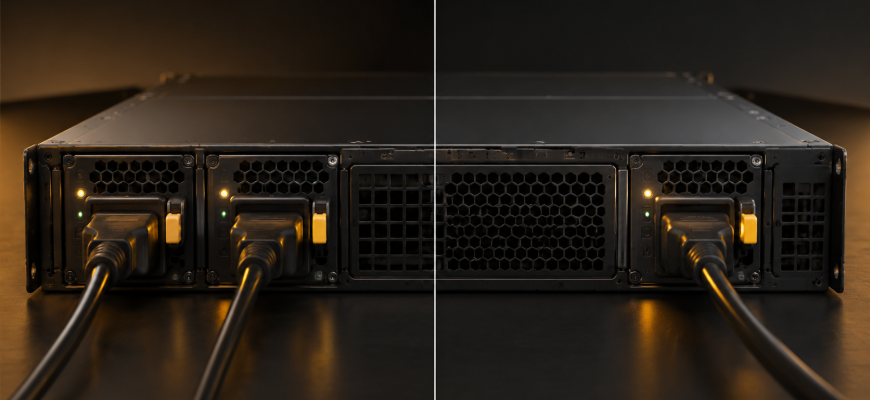
A second power supply does not make a server highly available by itself. It can protect against one power-supply module failing, and it can allow a module to be replaced without shutting down, but only when the server supports redundant operation and both inputs remain inside the validated power budget. If both supplies connect to the same failed power strip, the second module adds no path redundancy.
Decision in brief: use redundant hot-plug power supplies for production servers whose downtime costs more than the additional module and power-path design. Feed each PSU from an independent distribution path where practical. A single PSU is reasonable for non-critical, easily replaced systems when service interruption is acceptable and a spare is available.
- Separate component redundancy from power-path redundancy
- Single vs redundant PSU at a glance
- Criterion 1: business impact of a shutdown
- Criterion 2: redundancy mode and capacity
- Criterion 3: independent feeds
- Criterion 4: hot-plug serviceability
- Criterion 5: efficiency at actual load
- Criterion 6: matching, firmware and spares
- Criterion 7: monitoring and testing
- Criterion 8: cost and risk
- Recommended choices by scenario
- Standalone production server
- Virtualization cluster
- Development or laboratory server
- Edge location
- Buying checklist
Separate component redundancy from power-path redundancy
Two installed PSUs can provide redundancy against a module failure. They do not automatically protect against a failed rack PDU, tripped branch circuit, disconnected cable, failed UPS or utility outage. End-to-end resilience requires independent paths from the server inputs through distribution and upstream power.
Draw the path before specifying hardware:
- Server PSU A and PSU B
- Separate power cords
- Separate rack PDUs
- Independent upstream circuits or UPS outputs
- Facility power and generator design where required
Each shared component is a common failure point. Full independence may be unnecessary for a small business, but the buyer should know what the second PSU does and does not cover.
Single vs redundant PSU at a glance
| Criterion | Single PSU | Redundant PSUs |
|---|---|---|
| PSU failure | Usually stops the server | Service can continue if remaining capacity is sufficient |
| Hot replacement | Usually requires shutdown | Supported on hot-plug redundant designs |
| Power-path diversity | One input path | Possible only when inputs are fed independently |
| Acquisition cost | Lower | Higher module and cabling cost |
| Operational complexity | Simple | Requires capacity, feed and alarm validation |
| Best fit | Lab, backup or replaceable node | Production and maintenance-sensitive systems |
Criterion 1: business impact of a shutdown
Start with the cost and duration of an unplanned outage. A PSU failure in a standalone database server can interrupt an entire service. The same failure in one node of a properly sized cluster may have little user impact. Hardware redundancy should follow application architecture, not replace it.
Estimate detection time, technician travel, spare availability, replacement time and application recovery. If a single-PSU failure can create hours of downtime, the additional supply is usually inexpensive insurance. If the server is a disposable test node that can be rebuilt automatically, redundancy may add little value.
Criterion 2: redundancy mode and capacity
Servers may support modes described as 1+1, N+1 or non-redundant combined capacity. In a two-PSU 1+1 design, either module must be able to carry the server’s required load after the other fails. Installing two modules does not prove this condition. High-power CPUs, GPUs and drives can raise the configured load beyond what one PSU can support.
Use the server vendor’s configurator or power calculator for the exact bill of materials. Check both normal and failure states. If the system needs both supplies to meet peak power, the modules provide capacity but not full PSU redundancy.
Common mistake: ordering two smaller PSUs because their combined wattage exceeds the server estimate, then assuming the system remains redundant. The surviving module must support the permitted workload on its own.
Criterion 3: independent feeds
Connect redundant supplies to different rack PDUs when the availability target justifies it. Ideally those PDUs lead to separate protected circuits or UPS paths. Label both ends of each cord and monitor each feed. During maintenance, technicians must be able to identify which path can be isolated without removing all server power.
Two outlets on the same PDU are not independent. Two PDUs connected to the same circuit protect against a PDU failure but not a circuit failure. Document the exact coverage rather than using “A/B power” as an undefined label.
Criterion 4: hot-plug serviceability
Many enterprise servers allow a failed redundant PSU to be replaced while the system runs. Confirm hot-plug support for the exact model and follow the service procedure. Before removal, verify the remaining PSU is healthy, connected and capable of carrying the load.
Hot-plug reduces planned downtime but does not remove the need for maintenance controls. Pulling the healthy module because of poor labeling converts a repair into an outage. Use management-controller alerts, front-panel indicators and change procedures together.
Criterion 5: efficiency at actual load
Power-supply efficiency varies with load. In load-sharing mode, two modules may each operate at a lower percentage of rating than one module. Some servers provide an efficiency-oriented mode that keeps one supply more heavily loaded while the other remains ready. Behavior and terminology differ by vendor.
Do not assume that two PSUs double server power consumption; they share the output load, although conversion losses and control overhead differ. Likewise, do not select a very large wattage solely for perceived safety. Oversizing can place normal operation in a less favorable part of the efficiency curve. Use measured or vendor-calculated system load and retain the required failure margin.
Criterion 6: matching, firmware and spares
Server vendors commonly require compatible PSU models and ratings for redundant operation. Mixing wattages, efficiency classes or unsupported part numbers may disable redundancy or generate faults. Specify identical supported modules unless the technical guide explicitly permits another combination.
Keep at least one known-good spare for fleets where replacement response matters. A spare on a distant distributor shelf does not meet a short recovery objective. Standardizing server models and PSU part numbers can reduce the number of spares the organization must hold.
Criterion 7: monitoring and testing
Redundancy that is not monitored can fail silently. Configure alerts for lost input, failed PSU, redundancy degradation and power-cap events. Send them beyond the local server console. During commissioning, verify that disconnecting each input in turn leaves the server healthy and creates the expected alert.
Test one path at a time under a representative but controlled load. Confirm the remaining PSU does not overload and that the rack PDU and UPS have capacity for the transfer. A/B power design can shift load abruptly during a feed failure, so upstream devices must be sized for the failure state, not only normal load sharing.
Criterion 8: cost and risk
The TCO premium includes the second module, cord, PDU outlet, upstream capacity, monitoring and spares. Compare it with expected outage cost over the server’s useful life. Avoid false precision: use scenarios for low, medium and high impact.
For critical services, PSU redundancy is usually a low-cost layer but should sit beneath clustering, backups and tested recovery. For large replaceable fleets, software resilience may justify single-PSU nodes if failed systems can be removed without reducing capacity below target.
Recommended choices by scenario
Standalone production server
Choose redundant hot-plug PSUs and independent feeds where available. The application has no other node to absorb the failure, so component serviceability matters.
Virtualization cluster
Use redundant PSUs unless the cluster is deliberately designed around replaceable low-cost nodes and has enough reserve for failures. Verify feed loss does not remove several nodes from the same availability group.
Development or laboratory server
A single PSU can be reasonable when interruption is acceptable and replacement is quick. Keep backups and avoid making the lab system an undocumented production dependency.
Edge location
Redundant modules help only if two meaningful feeds exist. In a site with one circuit, consider whether a second PSU, a local spare or a complete spare server provides the best recovery time.
Buying checklist
- What outage does the second PSU need to prevent?
- Can one PSU carry the exact configured server at peak load?
- Are both modules identical and vendor-supported?
- Does the server support hot replacement in redundant mode?
- Are the two inputs connected to meaningfully separate paths?
- Can each PDU, circuit and UPS carry the failure-state load?
- Are redundancy-loss alerts configured and tested?
- Is a compatible spare available within the recovery objective?
Final recommendation: specify redundant hot-plug PSUs for production systems when an avoidable module failure would cause material downtime. Size each remaining path for the full permitted load and connect the inputs to separate distribution paths. Use a single PSU only as a conscious availability tradeoff for non-critical or genuinely replaceable servers.