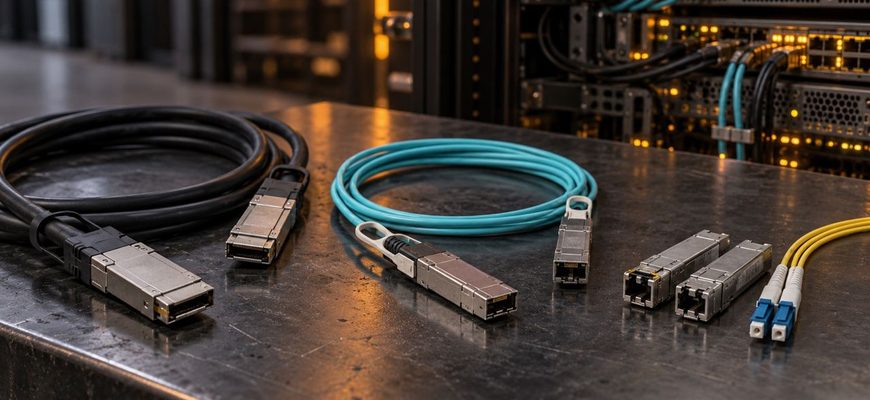
DAC vs AOC vs optical transceivers is a choice about reach, compatibility, serviceability, and cost. Choose a qualified passive DAC for a short, accessible server-to-switch connection when its reach and routing fit. Choose an AOC when the route needs an optical assembly without detachable fiber connectors. Choose separate optical transceivers and fiber when patch panels, longer distances, or independent component replacement justify the additional parts. The right purchase follows the physical route and endpoint requirements, rather than the assumption that optical networking is always an upgrade.
This comparison assumes that you have already selected the Ethernet speed. It addresses the next purchasing decision: how to connect the server NIC to the switch while controlling compatibility risk, installation effort, power, and replacement cost.
- Define the connection before comparing prices
- DAC vs AOC vs optical transceivers: direct comparison
- Compatibility can eliminate the cheapest option
- Verify both ends, not just the connector
- Include FEC in the purchase specification
- Reach, routing, and replacement determine practical value
- Buy for the installed route
- Account for the replacement boundary
- Compare the complete ownership cost
- Recommendations by deployment scenario
- A stable top-of-rack deployment
- A dense rack or a longer direct connection
- A breakout connection
- Final recommendation
- Procurement checklist
Define the connection before comparing prices
A cable quotation is incomplete without two identified endpoints and a measured route. Record the NIC model, switch model, port type, required link speed, and intended firmware. Then measure the installed path through cable managers, including service slack. Rack-to-rack distance measured across the floor is not the cable length you need.
Decide whether the connection will remain a direct run or pass through structured cabling. A fixed AOC cannot connect its internal fiber to a patch panel. A transceiver-and-fiber design can accommodate patching, provided the complete optical channel meets the selected interface requirements.
- Reach: Does the exact cable or optical pair support the complete route at the required speed?
- Endpoint support: Are both ends qualified for the proposed media and operating mode?
- Physical fit: Can the assembly meet bend-radius, clearance, and handling requirements?
- Replacement: Can a technician replace a failed part without disturbing unrelated connections?
- Lifecycle: Will the connection remain suitable if equipment moves or the port speed changes?
- Power: What is the consumption of the complete link, covering both endpoints?
- Total cost: What will the qualified connection cost after installation, spares, and replacement labor?
DAC vs AOC vs optical transceivers: direct comparison
Here, DAC means passive direct-attach copper. Active copper products are a separate option with their own power, reach, and qualification requirements. Do not treat an active cable quotation as interchangeable with a passive DAC.
| Decision criterion | Passive DAC | AOC | Transceivers + fiber |
|---|---|---|---|
| Assembly | Copper cable with fixed electrical ends | Fiber with fixed optical conversion at both ends | Separate modules and detachable fiber |
| Strongest fit | Short, accessible direct connections | Fixed direct runs where copper routing or reach is restrictive | Structured cabling and independently replaceable components |
| Signal processing | No active processing in the copper signal path | Active electronics at the ends | Active electronics in both modules |
| Typical replacement unit | Complete cable assembly | Complete cable assembly | Faulty module or fiber component |
| Purchasing risk | Assuming any matching connector or length will work | Ignoring endpoint support or replacement access | Mismatching optical interfaces, fiber, or connectors |
NVIDIA’s cable and connector documentation distinguishes passive DAC signal paths from AOCs with permanently attached fiber. Passive does not mean that the assembly contains no electronics: cable identification can still use EEPROMs.
At the same qualified Ethernet speed, paying for optical media does not itself increase the application throughput available from the port. Buy optics to solve reach, routing, or serviceability constraints. If bandwidth is the unresolved decision, use the separate 25GbE versus 100GbE server comparison first.
Compatibility can eliminate the cheapest option
Verify both ends, not just the connector
In the DAC vs AOC vs optical transceivers decision, compatibility is a pass-or-fail requirement. A mechanically fitting assembly is not evidence of supported operation. Check the NIC and switch compatibility documentation, including the exact cable or module part number, speed, firmware requirements, and any vendor restrictions. For example, Intel’s X710 SFP+ compatibility guidance specifies restrictions for supported optical modules and lists requirements for direct-attach cables. That is a product-specific rule, not a universal policy for every Intel adapter.
For mixed-vendor links, require evidence that the proposed assembly is accepted at both endpoints. A supplier’s claim that a cable is compatible with one switch family leaves the server side unresolved. Third-party media can be a reasonable purchase when qualification, support responsibility, and replacement terms are explicit.
Include FEC in the purchase specification
Forward error correction requirements can change with cable length and product. The Cisco 25GBASE SFP28 data sheet provides a concrete example:
| Listed Cisco passive DAC length | Documented host-port requirement |
|---|---|
| 1, 1.5, or 2 meters | FEC not required |
| 2.5 or 3 meters | BASE-R FEC |
| 4 or 5 meters | RS-FEC |
Product-specific example: these requirements describe the listed Cisco cable family. They are not generic limits for every 25GbE DAC. Confirm that both endpoints support the required mode for the exact assembly.
Reach, routing, and replacement determine practical value
Buy for the installed route
There is no single distance threshold that separates all DACs from all AOCs. Reach changes with speed, cable construction, and endpoint support. Cisco’s cited 25G portfolio lists passive copper lengths up to 5 meters and AOCs up to 10 meters; other product families differ. These examples establish why procurement needs a specific part number rather than a universal distance rule.
Physical handling can overturn an otherwise valid choice. A stiff bundle behind a densely populated switch can complicate cable management and service access. An AOC may make that route easier, but fiber still requires protection from excessive bending and pulling. NVIDIA’s cabling design guide emphasizes construction-specific bend limits; its cable-management FAQ distinguishes the cable’s bend radius from the larger radius that may apply near the connector.
Order enough slack for the documented maintenance procedure, without filling cable managers with unnecessary length. Check pull-tab access and whether an attached connector can pass through the intended pathway before selecting a fixed assembly.
Account for the replacement boundary
A DAC or AOC is purchased and replaced as an assembly. That is convenient for a visible direct run. It becomes costly when the cable is difficult to extract or several adjacent links must be disturbed.
Separate transceivers allow replacement of a failed module while leaving a sound fiber route in place. The trade-off is more detachable interfaces and separate parts to qualify, label, and stock. Optical connector inspection and cleaning also become part of the maintenance requirement. The advantage is modular replacement, not an automatic guarantee of greater reliability.
For separate optics, match the optical interface at both ends and verify fiber type, connector, polarity, and channel loss. A 100GbE label is insufficient: Cisco’s 100G module data sheet includes products using different optical interfaces and connector arrangements.
Compare the complete ownership cost
A useful DAC vs AOC vs optical transceivers cost comparison prices a complete working connection. For DAC and AOC, include the assembly and compatible spares. For separate optics, include a module at each end, the fiber path, any patching hardware, and the tools or service needed to maintain detachable optical connectors.
Then compare installation labor, replacement access, support coverage, and energy. Do not assume that AOC always costs less than separate optics, or that every DAC quotation is the cheapest. The useful comparison is between qualified configurations of the required length.
Use the incremental power of the complete link, covering both endpoints. As an illustrative calculation, 100 links consuming an additional 2 watts per link for five continuous years use 8,760 extra kWh: 100 × 2 × 8,760 × 5 ÷ 1,000. The 2-watt difference is an assumed input, not a measured DAC-to-AOC result. Apply the actual electricity tariff and account for cooling separately.
Future upgrades also have a replacement cost. Do not assume an existing DAC or AOC will support a higher link speed. Separate fiber may remain usable when transceivers change, but only if its fiber type, connector arrangement, reach, and loss budget satisfy the new optical interface.
A modular optical design can therefore be worth paying for on a difficult route. On an accessible short connection that will remain unchanged, the same flexibility may never produce a return.
Recommendations by deployment scenario
The following DAC vs AOC vs optical transceivers recommendations assume that each candidate meets the required Ethernet speed and endpoint qualification. A lower price cannot compensate for an unsupported connection.
| Scenario | Starting recommendation | Change the recommendation when |
|---|---|---|
| Server and switch in one rack | Qualified passive DAC | Routing, reach, or handling makes copper impractical |
| Fixed direct run across nearby racks | Evaluate AOC against a supported DAC | The route needs patch panels or difficult cable replacement |
| Existing structured fiber | Separate qualified transceivers | The fiber channel cannot meet the selected optical interface |
| Equipment moves or independent upgrades | Prefer modular optics where reuse is valuable | Expected changes do not justify extra parts and maintenance |
A stable top-of-rack deployment
Start with a passive DAC when every run is accessible and fits the supported length. Paying for AOC solely because the server runs a database, storage workload, or AI service adds no decision value. Those applications determine bandwidth and availability requirements; they do not independently require optical media.
A dense rack or a longer direct connection
Evaluate AOC when the copper alternative requires awkward bends, a bulky bundle, or an unsupported length. Make the premium conditional on an identified constraint. If the assembly cannot be replaced conveniently, quote separate optics as well.
A breakout connection
Specify the switch’s supported breakout mode before ordering the cable. Cisco documents 100G-to-four-25G copper assemblies, but the cable does not establish whether your switch supports the required port mode. Confirm the exact switch port, firmware, branch lengths, and server-end compatibility. Price spares around the whole assembly and the number of connections affected by replacement.
Final recommendation
DAC vs AOC vs optical transceivers: buy the simplest qualified connection that fits the installed route. Passive DAC is the starting choice for accessible short links. AOC earns its premium through useful reach and easier routing. Separate transceivers earn theirs through structured cabling and modular replacement. Change that recommendation when endpoint support, physical handling, or the upgrade plan rules out the simpler option.
Procurement checklist
- Record the exact NIC, switch, port, link speed, and firmware requirements.
- Measure the complete route, service slack, and connector clearances.
- Confirm support for the exact assembly or optical modules at both ends.
- Specify required FEC and any breakout mode before approving the order.
- For optics, verify interface, fiber type, connectors, polarity, and channel loss.
- Check bend limits, handling instructions, and any installation-rating requirements.
- Quote complete links, spares, installation, replacement labor, and power.
- Validate representative links in the intended hardware and firmware configuration before a fleet purchase.