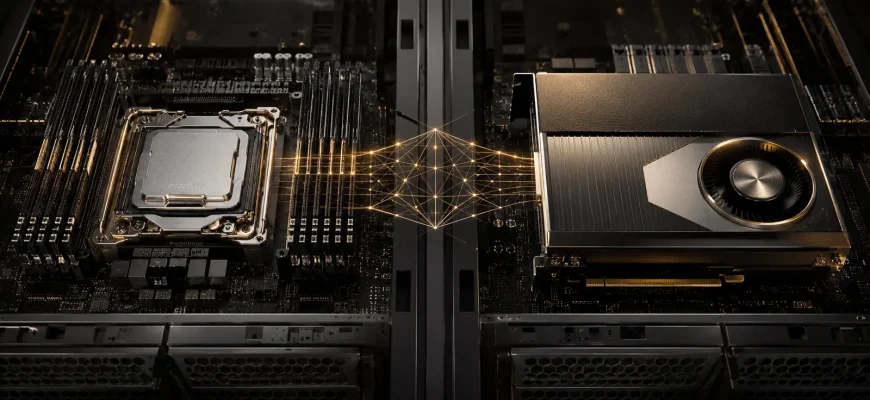
A GPU server is not the default answer to every AI inference workload. GPUs excel at highly parallel matrix operations and can deliver exceptional throughput, but they add acquisition cost, power, cooling and software constraints. CPUs remain attractive for small models, low request volume, latency-sensitive preprocessing and environments where inference shares a server with conventional applications.
Decision in brief: choose a GPU server when the validated model needs accelerator memory or when batching and concurrency keep the GPU productively occupied. Choose a CPU server when models are small, traffic is intermittent, deployment simplicity matters or existing CPU capacity meets the service-level target. Benchmark the complete serving stack before buying.
- Start with the inference service, not the accelerator
- CPU vs GPU inference at a glance
- Criterion 1: model size and memory placement
- Criterion 2: latency, throughput and batching
- Criterion 3: supported operators and serving software
- Criterion 4: utilization and consolidation
- Criterion 5: PCIe topology and multi-GPU scaling
- Criterion 6: availability and failure domains
- Criterion 7: five-year cost
- When a CPU server is the better purchase
- When a GPU server is justified
- A practical proof-of-concept plan
- Buying checklist
Start with the inference service, not the accelerator
Define the model, numerical precision, maximum input and output size, latency target, requests per second and expected concurrency. For generative models, separate time to first token from token-generation rate. For vision or recommendation systems, define batch size and tail latency. A single average latency number is not enough to size hardware.
Also define when demand occurs. A service receiving a steady stream of requests can keep a GPU busy. An internal tool receiving a few requests per minute may leave an expensive accelerator idle. Utilization changes cost per inference more than a peak benchmark result.
CPU vs GPU inference at a glance
| Criterion | CPU server | GPU server |
|---|---|---|
| Parallel throughput | Moderate; improves with cores and optimized libraries | Strong for supported highly parallel operations |
| Low-volume utilization | Can share capacity with other services | Dedicated accelerator may remain idle |
| Memory | Large system-memory capacity is relatively accessible | Fast accelerator memory is limited and expensive |
| Software path | Broad compatibility and simpler deployment | Framework, runtime, driver and model support must align |
| Power and cooling | Lower for modest inference configurations | Higher, especially with multiple accelerators |
| Best fit | Small models, low traffic and mixed workloads | Large models, high concurrency and sustained throughput |
Criterion 1: model size and memory placement
The model weights, runtime workspace and active request state must fit in available memory. A CPU server can access large pools of system RAM, although at much lower bandwidth than accelerator memory. A GPU can process supported operations rapidly when the working set stays in local high-bandwidth memory. If the model spills repeatedly across the PCIe bus or requires complex partitioning, expected performance may not materialize.
Quantization can reduce memory use and increase throughput, but it may affect output quality and requires runtime support. Treat each precision mode as a separate validated model. Do not size hardware from parameter count alone; architecture, context length, batch size and key-value cache requirements also change memory demand.
Criterion 2: latency, throughput and batching
GPUs achieve their strongest economics when many operations run in parallel. Batching several requests can improve throughput, but waiting to form a batch can add latency. A CPU may provide acceptable latency for one small request without queueing, while a GPU dominates when many requests arrive concurrently.
Measure at least three operating points: one request, expected concurrency and a peak condition. Report median and tail latency, not only average. For a public service, a high percentile such as the 95th or 99th is often closer to the user experience. The MLPerf Inference: Datacenter suite illustrates the importance of defined models, scenarios and metrics; its results are useful references, not substitutes for testing your own serving stack.
Criterion 3: supported operators and serving software
Hardware does not accelerate an unsupported execution path. Verify the framework export, runtime, operators, precision and model architecture on the exact target. A model may fall back to CPU for unsupported operations, spend excessive time transferring data or require a software version that conflicts with the rest of the environment.
For GPU deployments, record driver, firmware, runtime and framework versions as one tested bill of materials. For CPU deployments, enable the appropriate optimized libraries and instruction paths. Benchmark production preprocessing, tokenization, postprocessing and network serialization; these stages can remain CPU-bound even when the model runs on a GPU.
Common mistake: buying from theoretical operations per second or a vendor chart, then deploying a different model, precision, batch size and runtime. The only relevant performance is the validated service configuration.
Criterion 4: utilization and consolidation
A GPU costing several times more than a CPU configuration can still deliver lower cost per inference when heavily utilized. The same GPU is poor value at five percent utilization. Model hourly demand and determine whether several services can share the accelerator without violating latency or isolation requirements.
CPU inference often consolidates naturally with web, database and preprocessing services, but shared capacity needs limits. A burst of inference must not starve the application that feeds it. GPU sharing can improve utilization through separate processes, partitioning or scheduling, but support differs by accelerator and software stack.
Criterion 5: PCIe topology and multi-GPU scaling
A server that physically accepts a GPU is not automatically an appropriate inference platform. Check card dimensions, slot width, PCIe generation and lanes, auxiliary power, airflow direction, supported ambient temperature and vendor qualification. Consumer-style cards may lack the management, cooling or support expected in a server.
For multiple GPUs, determine whether each serves an independent model replica or whether one model spans devices. Replicas scale throughput more simply when each model fits on one GPU. Model parallelism introduces communication overhead and makes interconnect topology important. Do not assume two GPUs provide exactly twice the throughput.
Criterion 6: availability and failure domains
A single high-end GPU server can replace several CPU nodes but creates a larger failure domain. If inference is critical, size the remaining capacity to meet service targets during maintenance or failure. Two moderately sized accelerator servers may provide a better availability design than one fully populated chassis.
Check whether the application can route around a failed worker, reload models automatically and preserve warm capacity. Model-loading time matters after failover; a replacement instance that takes minutes to become ready may not meet the recovery objective.
Criterion 7: five-year cost
Include server chassis, CPUs, GPUs, memory, storage, networking, support, power, cooling and software. Some enterprise AI runtimes or management platforms require separate subscriptions. Include engineering time for model conversion, quantization and runtime maintenance when one option demands a specialized stack.
Calculate cost per successful request at expected utilization, not at maximum benchmark throughput. Use ranges for traffic growth and energy price. Accelerators often have a shorter economically useful cycle for fast-moving models, so test a three-year replacement case as well as the site’s standard five-year hardware horizon.
When a CPU server is the better purchase
- The model and runtime meet latency targets on a modest core count.
- Traffic is low or unpredictable and CPU capacity can be shared.
- Large system memory matters more than accelerator bandwidth.
- Operational simplicity and broad software compatibility are priorities.
- The workload is dominated by preprocessing, rules or database access.
When a GPU server is justified
- The model requires accelerator memory or supported tensor operations.
- Concurrency and batching produce sustained accelerator utilization.
- CPU testing cannot meet throughput or latency within practical node count.
- Power per completed inference improves despite higher server draw.
- The serving stack is validated and operationally supportable.
A practical proof-of-concept plan
- Freeze the model, precision, runtime and representative request set.
- Measure accuracy or output quality after any optimization.
- Test one request, expected concurrency and peak concurrency.
- Capture median and tail latency, throughput, memory and wall power.
- Include preprocessing, postprocessing and network overhead.
- Test restart, model loading and failover behavior.
- Calculate cost at expected utilization and growth.
Buying checklist
- What exact model, precision and context or input size will run?
- What are the latency and throughput service levels?
- Does the full working set fit in the chosen memory?
- Are all operators supported by the target runtime?
- What utilization will the system sustain?
- Is the chassis validated for the selected accelerator?
- How is capacity preserved during maintenance or failure?
- What is the cost per request at expected—not peak—load?
Final recommendation: benchmark CPU first for small models and low-volume services because it establishes the simplest viable baseline. Move to a GPU when that baseline misses latency, throughput or efficiency targets and the workload can keep an accelerator busy. Buy against a frozen model and serving stack; “AI workload” is not a hardware specification.