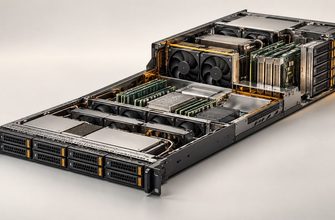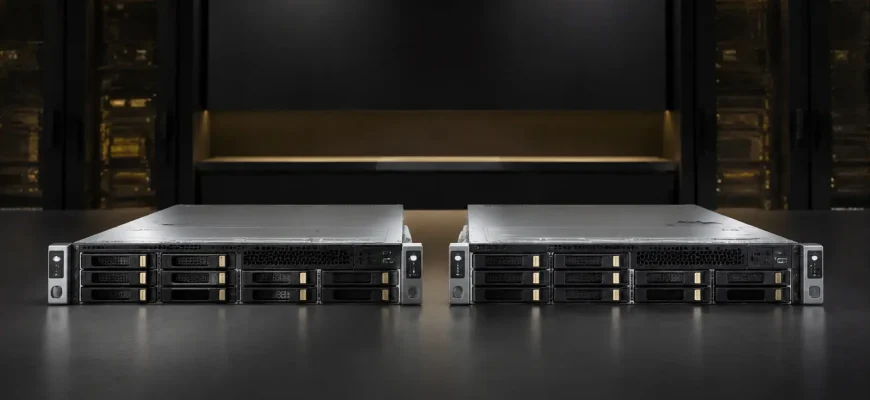
A refurbished server can cost far less than a current new system, but acquisition price is not total cost of ownership. The older platform may consume more power, require more units for the same workload, lose vendor support earlier or increase the value of spares held on site. Conversely, a new server can be an expensive way to run a stable workload that needs neither its performance nor its remaining support horizon.
Decision in brief: buy new for business-critical workloads that need a long support runway, current performance, high energy efficiency or certified compatibility. Consider professionally refurbished enterprise hardware for stable, replaceable and well-understood workloads when the seller provides traceable configuration, testing, warranty and spare availability. Compare both over the intended service period.
- Define “refurbished” before comparing prices
- The five-year TCO model
- New vs refurbished at a glance
- Criterion 1: equivalent workload capacity
- Criterion 2: software licensing
- Criterion 3: support horizon and firmware
- Criterion 4: warranty, failure risk and spares
- Components requiring explicit checks
- Criterion 5: energy and cooling
- Criterion 6: security and compliance
- Criterion 7: lead time and configuration risk
- Example TCO worksheet
- Recommended choices by scenario
- Core production platform
- Development, test and training lab
- Scale-out and replaceable workloads
- Power-constrained rack
- Buying checklist
Define “refurbished” before comparing prices
Used, refurbished and vendor-certified equipment are not equivalent. A used server may be sold as removed from service with minimal testing. A refurbisher may clean the system, run diagnostics, replace failed components and provide a warranty. A manufacturer-certified program may add controlled processes and support options, but terms vary.
Require the seller to state what was tested, which parts may be third-party replacements, whether firmware and management licenses are included, and how warranty claims are handled. Cosmetic grading says little about fans, drives, batteries, power supplies or memory.
The five-year TCO model
Use the same workload requirement and service period for both options. A basic model is:
Five-year TCO = purchase and configuration + software licenses + support and warranty + energy and cooling + expected failures and spares + migration labor − residual value.
Do not force a five-year horizon if the refurbished platform has only two sensible years left in the planned environment. Compare alternatives over the shorter defensible period or include the cost of an additional replacement.
New vs refurbished at a glance
| Criterion | New server | Refurbished server |
|---|---|---|
| Acquisition price | Higher | Usually lower |
| Support runway | Longest available | Shorter and model-dependent |
| Performance per node | Usually higher for current workloads | May require more nodes |
| Energy efficiency | Often better at equivalent work | Highly dependent on generation and utilization |
| Configuration certainty | Factory-configured and documented | Must be verified component by component |
| Lead time | Can vary with build-to-order supply | Fast when exact stock is available |
| Residual value | Potentially higher | Lower but with less capital at risk |
Criterion 1: equivalent workload capacity
Never compare one new server with one refurbished server merely because both occupy 2U or have two sockets. Compare the number of systems needed to meet the same performance, memory, storage, I/O and availability requirement. A new single-socket system can sometimes replace an older dual-socket configuration; in other cases a lightly loaded workload gains nothing from new silicon.
Benchmark the application or use a conservative capacity model. Include cluster reserve and failover. If three refurbished nodes are needed to match two new nodes, the older option also needs another set of memory, network ports, support tasks and software licenses.
Criterion 2: software licensing
Software frequently costs more than the server. Per-core licensing can penalize an older platform that needs more cores or sockets for the same work. Per-server licensing can penalize the alternative requiring more nodes. Subscription and support policies may also exclude hardware beyond a specified certification or support window.
Model the exact edition, metric and minimums using current publisher terms. Do not reuse the license cost from an existing server without checking whether licenses are transferable and whether the new deployment changes core or socket counts.
Common mistake: calculating a dramatic saving from used hardware while omitting the database, hypervisor or operating-system licenses attached to the extra cores.
Criterion 3: support horizon and firmware
A new server normally provides the longest period of vendor parts availability, firmware updates and support contracts. Refurbished equipment starts farther through its lifecycle. That can be acceptable when the intended use is short, isolated or easily replaced, but it is a poor fit when the application must remain certified for five years.
Check the specific model’s support status, not the product-family reputation. Confirm access to BIOS, controller, drive and management-controller firmware. Determine whether remote-management features require a transferable license. Ask who supplies parts after the original vendor ends standard support.
Criterion 4: warranty, failure risk and spares
Age alone does not predict an individual server failure, and a new server is not immune to early defects. Treat failure cost as a range. Include seller warranty, replacement response time, shipping, internal labor and business impact.
Refurbished fleets benefit from inexpensive complete spares or parts donors when configurations are standardized. One spare server can be economical for a lab or scale-out cluster. For a single critical host, a return-to-depot warranty may be inadequate even if the purchase price is low.
Components requiring explicit checks
- Drive health, endurance and remaining warranty
- RAID-controller cache protection battery or capacitor
- Fan and power-supply condition
- Memory diagnostics and corrected-error history, if available
- Remote-management license and account reset
- Rails, bezels, caddies, risers and proprietary cables
Criterion 5: energy and cooling
Newer servers often deliver more work per watt, but the saving depends on utilization and workload. An older server that idles most of the day can still accumulate significant energy cost. A new high-end system bought for a tiny workload may also be inefficient because most of its capacity remains unused.
Use wall-power measurements where possible. Model idle, typical and peak states over the actual duty cycle. Include power-supply efficiency and the facility’s cooling overhead. The ENERGY STAR enterprise server program provides a useful framework for examining server efficiency, but procurement should still use data for the exact configuration.
Criterion 6: security and compliance
Some environments require hardware-backed security features, supported cryptography, secure boot, current firmware or vendor attestation that older models cannot provide. Regulatory or customer contracts may require supported components even when the application technically runs.
For refurbished hardware, verify that the management controller has been reset, old credentials and certificates are removed, storage media is sanitized or replaced, and firmware can be brought to an approved baseline. Supply-chain provenance may matter for regulated deployments.
Criterion 7: lead time and configuration risk
Refurbished inventory can be available immediately, but an advertised model name does not guarantee identical processors, risers, controllers, drive caddies or power supplies. Require a line-item bill of materials and photograph or serial-number evidence for high-value orders. Define whether substitutions need written approval.
New build-to-order systems offer controlled configuration but may have longer lead times. Price the business cost of delay separately rather than hiding it inside hardware TCO.
Example TCO worksheet
| Cost line | Input to collect | Typical uncertainty |
|---|---|---|
| Hardware | Server, memory, storage, rails, NICs and spares | Substitutions and future upgrades |
| Software | Per-core, per-socket or per-server licenses | Publisher terms and growth |
| Support | Term, response level and covered parts | Post-warranty parts availability |
| Energy | Measured watts, duty cycle and energy price | Utilization and price changes |
| Failures | Expected incidents, labor and downtime cost | Failure rate and impact |
| Exit | Data erasure, disposal and residual value | Resale market |
Recommended choices by scenario
Core production platform
Prefer new when the workload is difficult to move, requires current certification or carries high downtime cost. Match the support term to the intended service life.
Development, test and training lab
Refurbished enterprise hardware can be strong value when downtime is tolerable and the platform exposes the same management and virtualization features the team needs to test.
Scale-out and replaceable workloads
Consider refurbished systems if the software tolerates node failure, capacity can be spread across identical units and complete spares are inexpensive. Include the operational cost of a larger node count.
Power-constrained rack
Prefer the option delivering the required work within the rack’s measured power and cooling budget. Acquisition savings do not compensate for a platform that prevents deployment density.
Buying checklist
- Are both options sized for the same workload and availability target?
- Is the exact bill of materials documented?
- Are firmware, management licenses and support status verified?
- Are software licenses included for the real core and server count?
- Has power been measured or conservatively modeled?
- What does the warranty cover and how fast is replacement?
- Which spares will be held and what do they cost?
- Does the service horizon extend through the planned use?
Final recommendation: choose new hardware when support runway, energy density, certification and downtime exposure dominate. Choose professionally refurbished hardware when the workload is stable, replaceable and inexpensive to license, and when the seller can document testing, configuration and warranty. Approve the purchase from a five-year worksheet, not from the discount percentage.